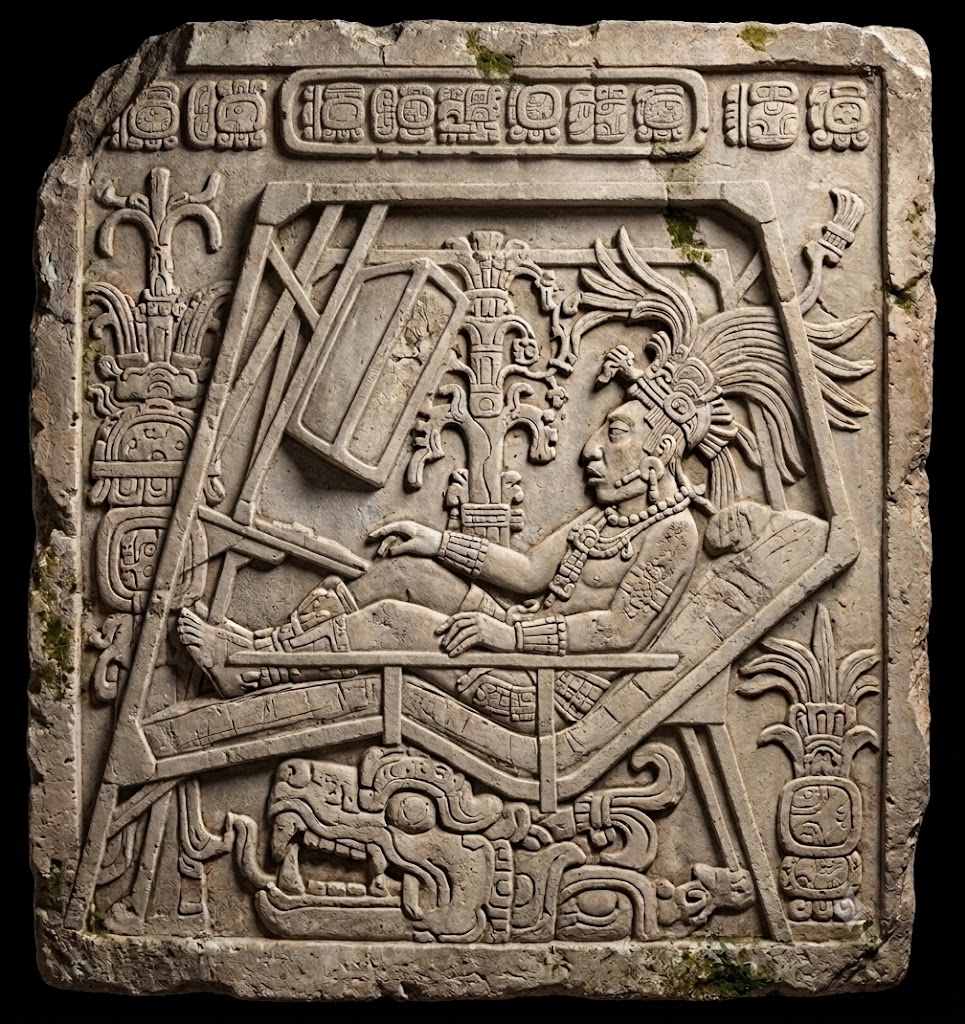
For decades, alternative historians and late-night documentary enthusiasts have gazed upon the magnificent sarcophagus lid of the Mayan ruler K'inich Janaab' Pakal in Palenque and arrived at a single, breathless conclusion: Spaceship.
They point to the intricate carvings. Look! they say. He’s operating controls! He’s wearing a breathing apparatus! He’s blasting off into the cosmos!
We hate to break it to the UFO community, but we’ve analyzed the angles, checked the posture, and consulted our top-tier spine guys. Pakal wasn’t navigating the Milky Way.
He was just a man desperately trying to invent the ultimate zero-gravity workstation.
The Great Mayan Ergonomic Struggle of 683 CE
Look closely at the carving. Pakal is leaning back, legs elevated, arms outstretched, staring intently at what is clearly the 7th-century equivalent of a dual-monitor setup. That’s not a rocket thruster beneath him; that’s the ancient struggle to find decent lumbar support.
The Mayans were undeniable geniuses. They mastered astronomy, invented the concept of zero, and built towering pyramids that still stand today. But let’s be brutally honest for a second: limestone makes for a terrible gaming chair.
Imagine being the ruler of a sprawling empire. You have endless decrees to dictate, architectural blueprints to review, and an inbox full of tribute requests. Sitting upright on a jagged rock slab all day is going to wreak havoc on your lower back. Pakal, an undisputed visionary, clearly instructed his royal artisans to design a solution.
“I want to recline,” we imagine him saying. “Elevate my feet. Angle my head so I can see my tablets without straining my neck. Give me that sweet, sweet zero-gravity posture.”
The artisans did their best. They sketched out the perfect ergonomic silhouette in the stone. They had the idea of the ideal lounge position perfectly mapped out. But sadly, they lacked memory foam.
What Pakal Dreamed, We Perfected
Fast forward a little over 1,300 years. The Mayans had the blueprint, but we finally cracked the code.
Here at Levus, we looked at Pakal’s ancient stone carving and said, "We can do this without the spinal contusions."
We took the brilliant concept of the elevated, reclined, pressure-relieving posture that the Palenque elites were striving for, and we completely stripped away the unforgiving rock, the confusing underworld serpents, and the neck strain.
Why the Levus Workstation is the True Heir to Palenque:
No Stone Necessary: Instead of hard limestone and elaborate carvings digging into your shoulder blades, we use industrial-strength comfort and adaptive support.
Optimal Screen Placement: Pakal had to stare up at the World Tree. You get perfectly mounted, eye-level monitors that don't require sacrifices to the rain god to keep from falling on your face.
The True Zero-Gravity Experience: While ancient theorists thought Pakal was defying gravity with rocket boosters, he was really just trying to decompress his spine. The Levus actually does it.
Your Turn to Rule
The next time you see that famous sarcophagus lid on a late-night history marathon, don't think of aliens. Think of a fellow professional, way ahead of his time, just wishing he had a softer place to put his mousepad.
Pakal tried to build the ultimate workstation out of stone and became an archaeological legend. Imagine what you can accomplish when you’re actually comfortable.
Skip the limestone. Upgrade to the 21st century. Get a Levus.