
Shopping Cart
Why the problem isn't your chair — and why replacing it won't fix anything
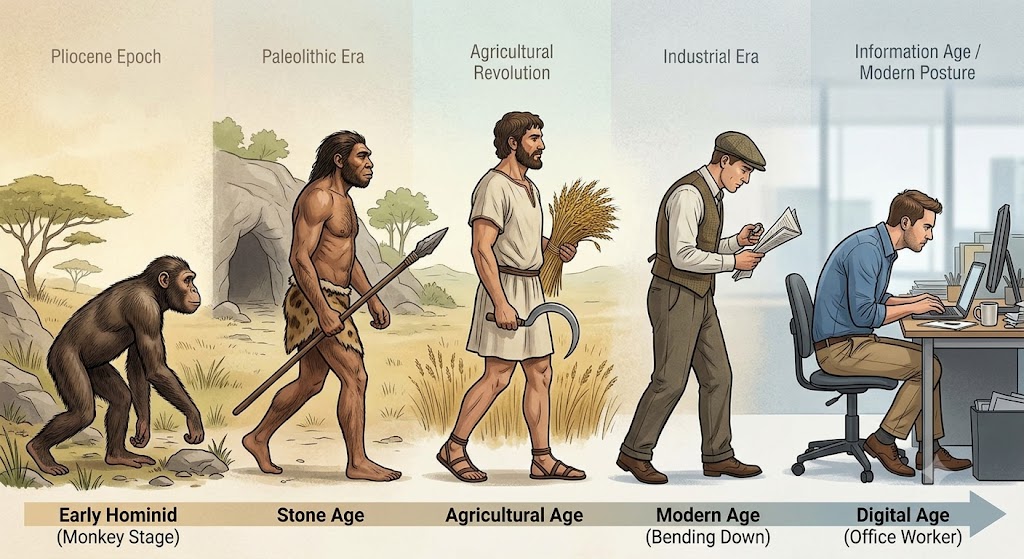
As we kept building LEVUS, we kept running into the same signal from every direction. Not recognition of LEVUS itself — almost nobody knew about us — but a shared dissatisfaction with the thing we had set out to replace: the classical chair-and-desk setup.
Some chairs are less uncomfortable than others. By the end of the day, all of them are uncomfortable.
Heavy computer users, full-time gamers, streamers, physiotherapists and clinical researchers are all warning about the same thing from their own angles. Office workers trade back-pain remedies on Reddit. Researchers run posture and load studies comparing workstation configurations. Nobody is converging on a single answer — but the recurring themes are consistent enough to be worth setting out. Here are the ones we find most convincing.
Galen Cranz and the "chair–desk complex"
Galen Cranz, Professor Emerita of Architecture at UC Berkeley, is the sharpest critic of what she calls the chair–desk complex. A sociologist by training and a certified Alexander Technique teacher, she spent a career arguing that almost everything we believe about sitting is inherited convention dressed up as ergonomics.
Her book The Chair: Rethinking Culture, Body, and Design (W. W. Norton, 1998) is approaching thirty years old and reads as more relevant now than when it was published. She traces how Western civilisation became obsessed with the chair as a status object, then shows what that obsession costs us. She debunks the standard ergonomic dogmas — including the sacred principle of lumbar support — and she is not gentle with the famous designer chairs of Modernism, which by her account are frequently worse than ordinary office furniture.
It remains the one book we would put in the hands of anyone who cares about health and comfort at a workplace.
Cranz introduces the idea of the perch: a hybrid between sitting and standing that opens the hip–spine angle and is kinder to the body than either upright sitting or prolonged standing. She goes further and argues that a properly supported reclined position — the lounge chaise — is among the healthiest working postures available. (Her own lounge-chair prototypes were stolen from a functional-art exhibition, which is its own kind of endorsement.)
In the chapter where she describes her ideal workplace, she suggests that for word processing you might "recline in a lounge chair with the keyboard on your lap" and mount the screen at an angle.
We read that and stopped. It is a precise description of the LEVUS ZERO-G workstation, written independently, decades before we built it. Cranz's faculty page and publication list: ced.berkeley.edu/people/galen-cranz. Her broader work on body-conscious design: bodyconsciousdesign.com
From perch to recline: what the measurements actually show
The perch is a compromise. The interesting question is what happens when you go past it.
In 2006, a team led by Waseem Bashir, using a positional MRI scanner — one that lets the subject sit or stand rather than lie flat — imaged healthy volunteers in three postures: slouched forward, upright at 90°, and reclined at a 135° trunk–thigh angle. The reclined posture produced the least spinal disc movement and the best-preserved disc height. Slouching was worst; the upright 90° "correct" posture that everyone is nagged into was close behind it. The follow-up analysis of intervertebral disc water content ranked the postures the same way: lying flat best, 135° next, 90° worst.
This is the study to cite when someone insists that sitting up straight is virtuous. It isn't. It's just familiar.
The finding is not an outlier. Classical intradiscal-pressure work going back to Nachemson's studies in the 1960s and 70s pointed the same direction: leaning the backrest back substantially reduces lumbar disc pressure compared with unsupported upright sitting.
The zero-gravity reference point
There is a second, independent line of evidence that we think belongs in this conversation, and it comes from space. When NASA photographed Skylab crew members floating in microgravity and told them to relax, their bodies settled into a consistent configuration: hips and knees flexed, shoulders slightly abducted, arms floating forward, neck neutral, spine holding its natural curves. NASA called it the Neutral Body Posture and wrote it into its human-systems standards (originally NASA-STD-3000, now NASA-STD-3001). Later work aboard STS-57 showed it is a range of postures rather than one fixed geometry, but the commonalities held.
This matters because it is the closest thing we have to an answer to the question "what shape does the human body take when nothing is pushing on it?" It is not a 90° angle. It is an open, reclined, lightly flexed posture — and it is where the term zero-gravity seating comes from. Nissan built a driver's seat around it. We built a workstation around it.
What "sitting is the new smoking" gets right and wrong
The slogan is catchy and it is overstated. Sitting is not a disease and there is no diagnostic code for it.
What the epidemiology actually shows is more useful. Ekelund's 2016 Lancet meta-analysis, pooling data from over a million adults, found that people who sat more than eight hours a day and were physically inactive carried a mortality risk comparable to smoking or obesity — but that roughly 60–75 minutes of moderate daily activity essentially eliminated the excess risk attributable to sitting time. The dominant variable was inactivity, not the chair.
We think this is the honest framing, and it is also better for us than the scare version. The enemy is static loading and lack of movement, not the act of sitting. A posture that lowers spinal load, keeps the hip–spine angle open and supports the head is a better place to spend eight hours — but no posture, ours included, substitutes for getting up and moving.
The same caveat applies to the standing desk, which is often sold as the cure. Prolonged standing has its own well-documented costs: venous pooling, lower-limb fatigue and swelling, and in occupational studies, elevated cardiovascular risk in workers who stand all day. Swapping one static posture for another static posture is not a solution. It's a different problem.
Other reformers worth reading
Peter Opsvik, the Norwegian designer behind the Balans kneeling chair and the Tripp Trapp, was among the first to attack the upright posture as a design assumption rather than a fact of nature. The principle usually attributed to him — the best posture is the next posture — is hard to argue with. Regular changes of position, breaks and stretches are essential to blood flow and muscle condition regardless of what you're sitting in.
Others advocate saddle chairs, kneeling chairs, or height-adjustable desks. They share a diagnosis with us even when they disagree on the remedy.
The LC4, and what 1928 got right
LEVUS is directly inspired by the LC4 chaise longue — designed in 1928 by Charlotte Perriand, Le Corbusier and Pierre Jeanneret. It is the timeless statement of the reclined body: an adjustable, continuously tilting frame that supports the whole length of a person and lets them choose their angle.
If there had been computers in 1928, we're fairly sure that team would have designed monitor arms and a mouse table to go with it. Which is the point. Why suffer through your working day when the geometry to avoid it has existed for a century? Many therapists already recommend a reclined position to patients with back pain.
But be careful with the obvious shortcut. Reclining on a sofa or a lounge chair with a laptop on your knees gives away everything the posture earns you: your neck goes into hard forward flexion to see the screen, your arms lose support, and your spine slumps into a C. The recline is only worth having if the equipment recline is designed around it.
Fix the whole complex, not one component
Whoever your expert or supplier is, make sure they are addressing the full chair–table–equipment–body system. Most chair designers are still preoccupied with silhouette, material and finish — mesh fabric being the current fixation. A chair remains a subconscious status object, and people routinely trade away their health for one.
You cannot improve a workplace by swapping one chair for another. All four components have to be re-evaluated together:
Chair — reclined position, solid planar support surfaces, and — critically — shoulder and head support. Without head support, recline does nothing for the neck.
Table — once the chair changes, the desk has to be resized and repositioned. A narrow, functional mouse table that holds a coffee, a notepad and a phone is enough. Nobody uses plastic in/out trays anymore. Nobody should be printing quarterly reports. So why is the standard desk still two square metres?
Equipment — monitors go on arms, positioned at your natural gaze angle so the neck never tilts forward. Multi-monitor setups are worth it; the frequently quoted "30% productivity gain" comes from vendor-sponsored research and should be treated as directional rather than precise, but the ergonomic case for getting screens off the desk and onto arms stands on its own. Keyboard and pointing device need to be supported by the chair, not held up by your shoulders.
Body — listen to it. Build awareness of how you use it. Take real breaks and change position often. Nobody operates at 100% from nine to five, and no chair will change that.
Where recline doesn't fit
We would rather say this ourselves than have you discover it.
A reclined workstation is optimised for long, focused, screen-based work. It is not the right tool for handwriting, for sketching on paper, for a meeting where you need to stand up every four minutes, or for a hot desk you'll leave in an hour. It takes up more floor area than a chair pushed under a desk. And it takes most people a few days to stop feeling like they should be sitting up.
If your work is genuinely varied and mobile, a reclined workstation should be one station among several — the one you go to for the deep four-hour block. That is the honest version of the claim, and it is still a large fraction of most people's working lives.
Our philosophy at LEVUS is to get all four components right and integrate them into a single environment. Not a better chair. A different premise.